Human Rights System of the African Union
(AU)

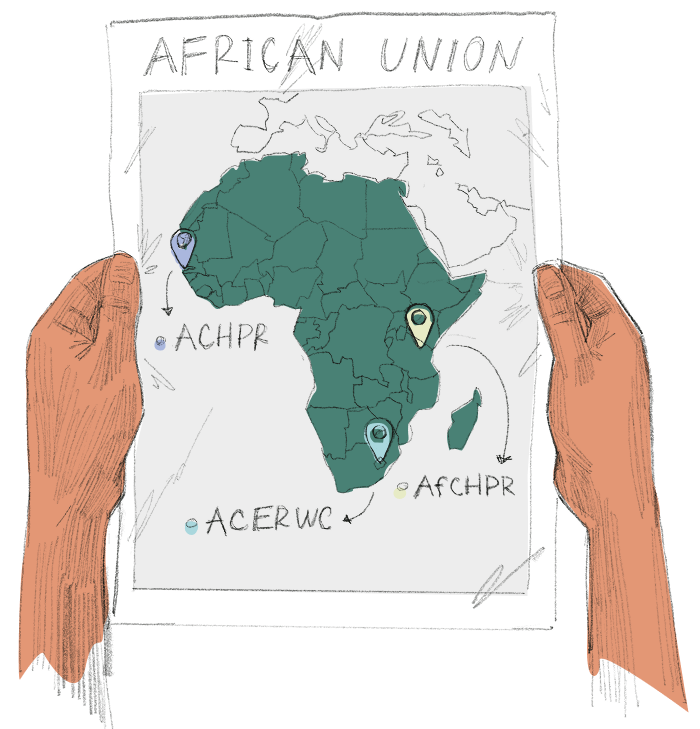
The African Human Rights System encompasses human rights norms and supervisory/monitoring/accountability bodies established by the African Union. It is made up of three primary organs the African Commission on Human and Peoples' Rights (ACHPR), the African Court on Human and Peoples’ Rights (AfCHPR), and the African Committee of Experts on the Rights and Welfare of the Child (ACERWC).

The three organs are composed of eleven members (“Commissioners” in the case of the ACHPR, “Judges” in the case of the AfCHPR, and “Experts” for the ACERWC). The term of office for the members of the ACHPR and ACtHPR is six years, and five years for the ACERWC. For all mechanisms, individuals may be nominated for re-election for the same term only once.

African Commission on Human & Peoples’ Rights (ACHPR)

The ACHPR is the treaty body established by the African Charter on Human and Peoples’ Rights (African Charter) with the mandate to promote and ensure the protection of human and peoples’ rights in Africa. Its function is mainly governed by the African Charter, the Rules of Procedure and Practice Directions. The ACHPR is based in Banjul, the Gambia.

List of Special Mechanisms:

To advance specific areas of work, the ACHPR has established subsidiary mechanisms, including special working groups, special rapporteurs, and committees. Since 2000, the ACHPR has established a total of 16 subsidiary mechanisms that preside over specific areas such as the death penalty, freedom of expression, women's rights, and torture.

In compliance with its mandate, the ACHPR can, among others:

  • Interpret all the provisions of the African Charter as well as other human rights instruments.
  • Accept and consider Inter-State and individual communications alleging human rights obligations by state parties to the African Charter, and issue recommendations.
  • Issue provisional measures and urgent appeals.
  • Undertake research and make recommendations to state parties, adopting resolutions, formulating principles and guidelines, and cooperating with other African and International institutions.
  • Refer cases of human rights violations to the African Court on Human and Peoples’ Rights.
  • Conduct country visits.
  • Receive and consider periodic reports of state parties on measures they have adopted which give effect to the provisions of the African Charter.

African Court on Human and Peoples Rights (AfCHPR)

The AfCHPR is the regional court for the protection of human rights. The purpose of the court is to complement and reinforce the functions of the ACHPR relating to the consideration of individual complaints and inter-state disputes on human rights matters and to act as the African Union’s premier human rights body that also interprets the African Charter and other human rights instruments. Its function is mainly governed by the African Charter, the Protocol to the African Charter on Human and Peoples’ Rights for the Establishment of the African Court on Human and Peoples’ Rights (AfCHPR Protocol), as well as the Rules of Procedure and Practice Directions. which are issued from time to time by the Court. The Court's decisions are binding. The Court is located in Arusha, Tanzania. .

In compliance with its mandate, the AfCHPR can, among others:

  • Accept and consider contentious cases alleging human rights obligations by States. The African Court may issue provisional measures in cases of extreme gravity and urgency pending the final determination of contentious cases.
  • Issue Advisory Opinions upon requests sent by member states or other AU organs
  • Refer cases to the ACHPR for determination.

African Committee of Experts on the Rights and Welfare of the Child (ACERWC)

The ACERWC is a treaty body of the African Union established to monitor the implementation of the African Charter on the Rights and Welfare of the Child, interpret the provisions of the Charter, and protect the rights of children in Africa. Its functions are mainly governed by the African Charter on the Rights and Welfare of the Child, as well as the Rules of Procedure and Practice Directions. The Committee is based in Maseru, Lesotho.

The ACERWC can, among others:

  • Promote and monitor the implementation of all the provisions of the African Charter on the Rights and Welfare of the Child.
  • Interpret the African Charter on the Rights and Welfare of the Child at the request of a state party, AU organs or other organisations recognised by the AU or member states.
  • Accept and consider contentious communications alleging children’s rights violations by States and issue recommendations.
  • Receive and consider periodic reports of state parties on measures they have adopted which give effect to the provisions of the African Charter on the Rights and Welfare of the Child.
  • Undertake research and make recommendations to state parties, adopting resolutions, formulating principles and guidelines, and cooperating with other African and international institutions.
  • · STEP 1 ·
  • requirements
  • · STEP 1 ·
  • requirements
  • · STEP 1 ·
  • requirements

Eligibility requirements for members of African human rights mechanisms

I. Requirements

1. Individual criteria

Individual requirements to serve on the ACHPR

The requirements for nomination and selection of the 11 commissioners of the ACHPR are derived from the African Charter on Human and Peoples’ Rights and the ACHPR’s Rules of Procedure. Commissioners must possess the following qualifications:

  • National of one of the parties to the African Charter on Human and Peoples’ Right.
  • Chosen from those with the highest reputation, known for high moral standards, integrity, impartiality, and competence in human and peoples’ rights.
  • No two commissioners can be nationals of the same State.
  • New commissioners must be from the same region and the same gender as the outgoing commissioner to conform to gender and regional parity rules.
    • Example: An outgoing female commissioner from the South region must be replaced by another female commissioner from the South region.
    • Exception: The 11th seat (also known as the “floating seat”) rotates between the different regions.
Individual requirements to serve on the AfCHPR

The requirements for nomination and election to the 11 judges of the AfCHRPR are derived from the AfCHPR Protocol and other African Union Standards, including rules on gender parity and regional representation. Judges on the African Court must possess the following qualifications:

  • National of one of the Member States of the African Union.
  • Jurist of high moral character.
  • Recognized practical, judicial, or academic competence and experience in the field of human and peoples’ rights.
  • Independent and impartial; cannot hold any political, diplomatic, or administrative position in the government.
  • Should have experience in more than one of the principal legal traditions of Africa (Civil Law, Common Law, Islamic Law and Custom and African Customary Law).
  • No two judges can be nationals of the same State.
  • New judges must be from the same region and the same gender as the outgoing judge to conform to gender and regional parity rules.
    • Example: An outgoing female judge from the South region must be replaced by another female judge from the South region.
    • Exception: The 11th seat (also known as the “floating seat”) rotates between the different regions.
Individual requirements to serve on the ACERWC:

The requirements for nomination and selection of the 11 experts of the ACERWC are derived from the African Charter on the Rights and Welfare of the Child. Experts must possess the following qualifications:

  • National of one of the parties to the African Charter on the Rights and Welfare of the Child.
  • High moral standing, integrity, impartiality, and competence in matters of the rights and welfare of the child.
  • No two experts can be nationals of the same State.
  • New experts must be from the same region and the same gender as the outgoing expert to conform to gender and regional parity rules.
    • Example: An outgoing female expert from the South region must be replaced by another female expert from the South region.
    • Exception: The 11th seat (also known as the “floating seat”) rotates between the different regions.

2. Criteria regarding the composition of the organs as a whole

The AU Executive Council, in the January 2016 Decision on the Modalities on Implementation of Criteria for Equitable Geographical and Gender Representation in the African Union Organs EX.CL/953 (XXVIII), decided on additional requirements to ensure equitable regional and gender representation on all AU organs, including the human rights mechanisms.

  • 1. Regional representation

    The AU has divided the continent into five regions: East, Central, North, South, and West. A list of which countries lie in which region can be found here. For all of the human rights mechanisms, which have 11 members, there are 2 members that come from each region. The last eleventh member occupies the last “floating” seat, which rotates among the regions.

  • 2. Gender representation

    Each human rights mechanism is required to have at least one woman from each region. The practice has been to ensure that there is at least one man and one woman from each region. The last eleventh “floating” seat can be occupied by either gender.

Gender parity is a unique feature of the African human rights system that guarantees gender representation in all Nomination and selection processes.

  • · STEP 2 ·
  • Nomination
  • · STEP 2 ·
  • Nomination
  • · STEP 2 ·
  • Nomination

Summary of Nominations, Submissions, and Election Process

II. Nomination

African Commission on Human and Peoples’ Rights (ACHPR)
  • 4 months before the elections, the AU Office of Legal Counsel must send a note verbale to invite all states parties to the Charter soliciting nominations.
    • 1 month before the election, the AU Commission makes an alphabetical list of names of candidates and sends it to all AU Member States.
  • Each state party to the Charter can nominate up to two candidates, but they must be nationals of a state party to the Charter; both cannot be nationals of the nominating state.
  • Commissioners are elected by a secret ballot by the Executive Council of the African Union.
  • 11 commissioners are elected for 6-year terms and are eligible for reelection once.
African Court (AfCHPR)
  • The AU Office of Legal Counsel (OLC) sends out a note verbale to state parties soliciting nominations to be presented within 90 days of the request.
  • States may propose up to three candidates, and at least two of them shall be nationals of the nominating state.
  • The AU creates an alphabetical list of the candidates and sends it to all AU Member States one month before the election.
  • Judges are selected by a secret ballot from the list of candidates by the Executive Council of the African Union.
  • 11 judges are elected for 6 years and may only be re-elected once.
African Committee of Experts on the Rights and Welfare of the Child (ACERWC)
  • The AU sends a note verbale soliciting nominations from state parties to the African Charter on the Rights and Welfare of the Child six months in advance. While the Charter does not prescribe when states are expected to submit their nominations, this information is usually contained in the note verbale.
  • Each state party to the African Charter on the Rights and Welfare of the Child can nominate up to two candidates, each of which must be a national of a State party to the Charter on the Rights and Welfare of the Child; both cannot be nationals of the nominating state.
  • There can only be one national of any given state party serving on the Committee simultaneously.
  • The AU Executive Council elects members of the Committee by secret ballot from a list of people nominated by the State Parties to the Charter.
  • 11 members are elected for five-year terms and are eligible for reelection once.

In the February 2020 Decision on Delegation of Authority for the Election and Appointment of Members of AU Institutions within the Framework of One Ordinary Summit a Year Dec. 760 (XXXIII), the AU Assembly of Heads of State and Government decided to delegate its authority to elect members of human rights mechanisms to the Executive Council. From that point on, instead of the Assembly taking a vote by secret ballot, it is the Executive Council that elects members of the African Court on Human and Peoples’ Rights, the African Commission on Human and Peoples’ Rights, and the African Committee of Experts on the Rights and Welfare of the Child, among other AU institutions. The Executive Council coordinates and takes decisions on policies in areas of common interest of Member States. It is responsible to the Assembly of States and Governments and is composed of foreign ministers or such other ministers or authorities as are designated by the governments of the Member States.

B. Requirements for National Selection Processes

There are no uniform processes for the national nomination for the AU human rights mechanisms. However, the notes verbales sent out to solicit nominations include the following directions:

1

Member states are expected to request interested candidates to complete biographical information indicating judicial, practical, academic, activist, professional, and other relevant experience in the field of human and peoples' rights. Such biographical information should also include information on political and other associations relevant to determining questions of both eligibility and incompatibility. In addition, nominees should submit statements indicating how they fulfil the criteria for eligibility contained in the Charter.

2

Member States are expected to ensure regional and gender representation in their nominations in line with the policy of the African Union.

3

On independence and impartiality the note verbal states as follow “ As a guide for States Parties in interpreting the question of incompatibility or impartiality, the Advisory Committee of Jurists in the establishment of the Permanent Court of International Justice (now the International Court of Justice (ICJ) had pointed out that “(A) member of government, a Minister or under-secretary of State, a diplomatic representative, a director of a ministry, or one of his subordinates, or the legal adviser to a foreign office, though they would be eligible for appointment as arbitrators to the Permanent Court of Arbitration of 1899, are certainly not eligible for appointment as judges upon our Court.”

4

Member States may:

a)The procedure for nomination of candidates should, at a minimum, be that for appointment to the highest judicial office in the State Party.
b)Encourage the participation of civil society, including judicial and other state bodies, bar associations, academic and human rights organizations, and women’s groups, in the process of selecting nominees.
c) Employ a transparent and impartial national selection procedure to create public trust in the integrity of the nomination process.

  • · STEP 3 ·
  • Presentation
  • · STEP 3 ·
  • Presentation
  • · STEP 3 ·
  • Presentation

III. Submission and evaluation of applications

At the end of the nomination period, State Parties usually send their nominations accompanied by curricula vitae to the Office of the Legal Counsel of the African Union through a designated email address. The note verbale directs that note verbales should not exceed 3 pages, single-spaced, and should be submitted in at least 2 working languages of the African Union.

At the close of the nomination period, the Office of the Legal Counsel of the African Union reviews the nominations to ensure that they are in accordance with the criteria established by the respective instruments of the mechanisms and requirements for the vacancies. Nominations that do not meet the criteria or requirements may be rejected. In addition, the Office of the Legal Counsel of the African Union will not consider nominations that are received after the deadline.

At the end of the evaluation process and at least one month before the election, the AU Commission will make an alphabetical list of all candidates and send it to all AU member states.

  • · STEP 4 ·
  • Selection
  • · STEP 4 ·
  • Selection
  • · STEP 4 ·
  • Selection

IV. Election of Candidates

In the African human rights mechanisms, the Executive Council of the African Union elects members, typically through a secret ballot process that continues until one candidate receives a two-thirds majority of the votes. This procedure applies in competitive elections where more than one candidate is contesting the position. In situations where there is only a single candidate, the process is typically straightforward, and the nominee generally receives the required two-thirds majority automatically. Sometimes, states withdraw their candidates just before elections, suggesting the practice of vote trading among states, similar to what occurs in other contexts.

We know that reaching this point is a long and complex journey. At GQUAL and the Arusha Initiative, we hope that this tool will help to better understand and to improve the processes so that more women lead spaces in international justice.